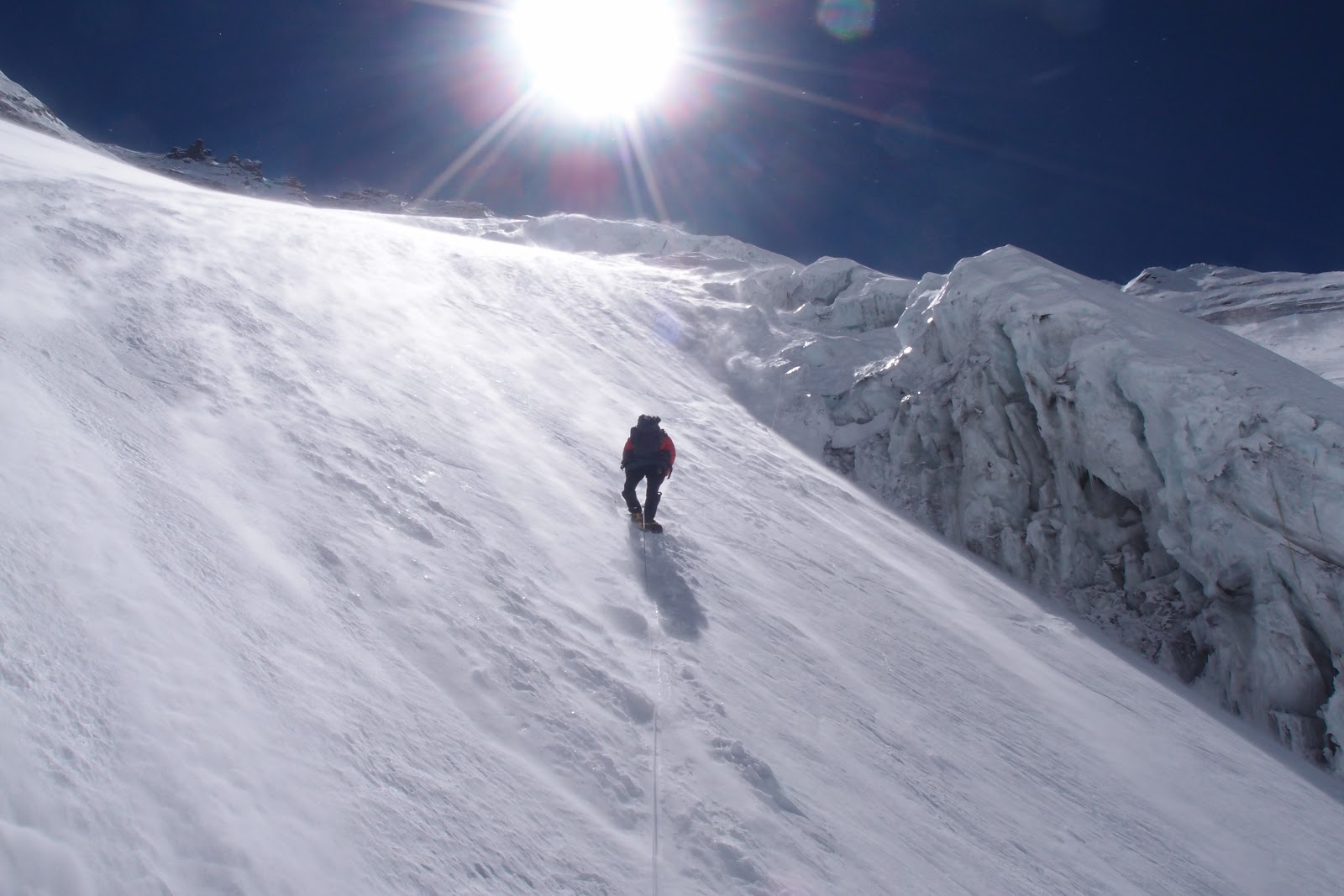
Thursday, January 31, 2013

Preparing Climbing at the Base Camp

Arriving at the Everest base camp area, the elevation of which is 5350 meters above sea level, all the people firstly set up the camps.

Arranging the Dining tent.  Sedentary style is, as far as I know, only applied by Koreans as for the dining tent in mountaineering expeditions.


Early September, snowing at the base camp.


Having dinner with head-light, for the electricity has not yet been settled

Evening the camp ground

Make a table of sedentary style with plastic boxes

The first three days they organized the huge amount of luggage

A SPCC (Sagarmatha Pollution Control Committee) person.  Composed of several local Sherpas, they set up the route from the Khumbu glacier to the Camp 2 (6500 meters), with, of course, payed.  This person came up to us to borrow the "Korean rope" to fix the route.


Lingtren shines behind the base tents.


A Korean member with a Sherpa organizing luggage into the storehouse

Tents for the high camps also need to be checked again and finally

Puja at the base camp.  Climbing gears were dedicated to the mountain god


Wednesday, January 30, 2013

Leaving into a journey

One would say, there is a liminal -- Latin, meaning threshold -- period that clearly separates before and after.

Flying over the large capital, Kathmandu


Landing onto the Tenzing-Hillary (Lukla) Airport, which is scary enough to be almost always a signal, for the visitors, to start their journey.


Looking up the Himalayan mountains on the way to Thukla (4600 meters) 


It is my argument, however, there CANNOT be a period of such, that distinctly separates two different phases and that a person can grasp into his mind.  This is rather a philosophical thought, against most structuralist theorists.  I will return to this theme later.


Launching Expedition

The Korean Everest expedition, named "2012 Korean Peace Expedition," is composed of ten Koreans.  Most of them are in their twenties; only one among them -- myself -- has experienced the low level of oxygen in the air above 8,000 meters.

They initially have planned to climb the "Kangshung Face," the immense east face of the highest mountain.  The face is one of the hardest face in the world to climb on, as George Mallory who "discovered" the face firstly ever among the climb-minded people in 1921 mentioned like (I don't remember the exact words) 'only stupids may think to climb this.'  Now, there has been established two routes.

the immense Kangshung face of Mt. Everest (click to enlarge)

The Koreans had planned to climb through a new route, via east ridge which called "Fantasy ridge."  Three teams had tried so far the unclimbed route, returning their home in vain.

The "Fantasy Ridge" - behind the climbers - and the Kangshung glacier, seen from 8600 meters on the southeast ridge of Mt. Everest. (click to enlarge)

However, it was at a hotel in Kathmandu where they finally decided to climb the popular Southeast ridge.  The Chinese government had rejected all the applications of Visa into the territory of Xizang (Tibet) province, only for the mountaineering purpose.  People guessed, as a political vote of the region has been scheduled, the government has been afraid of any riot involving foreigners, especially of the "radical-minded" mountaineers.

"I once thought to forgive up the expedition," the leader said.  The climb, especially only through the scary ridge, was his dearest wish.

And, the name "Peace" of the expedition meant symbolically a reunion of North and South Korea by executing a joint expedition, as it had planned but failed to make.  

Puja for the members

After arriving Kathmandu, usually a few days the climbers from another country stay at the capital for buying some goods, joining with their guides and so on.  The first glimpse of Nepal, a country struggled severe turmoils ranging all the sectors of its society currently, only serves to the nature-lovers' eyes as fragments of confusion, though.  

To them, the political, ethnic conflicts, or any other concerned to the native, ongoing within the society would endow least meaning.  If you say, "fighting against nature" as such has always been the single most significant to the people who leading one's own life for such a way.  

For Sherpa (in terms of the occupational), the Himalayan guides as their way of caste, on the other hand, to climb a highest mountain always involve danger, danger which man may not be in control.  Safety will be met only if you be guided by any unknown being, which usually understood as god.  Any kind of puja (religious service) practiced by Nepalese shows their pray for their future.  It is of course true to Sherpas, as they do so before getting into mountains as guides.  

This autumn season, it has been known that no lama (Buddhist priest) will be joining as a Sherpa with the climbers on Mt. Everest and Mt. Lhotse as well.  So, the four Sherpas hired by the Korean Everest Expedition decided to visit a gompa (temple) at the famous Boudhanath for worship.  Korean members also had been invited to join them.

Puja in a gompa at Bouddhanath, Kathmandu

However, as things turn out, a "big" lama has been invited to the Everest base camp for perform a puja.  "More is good," one Sherpa said.  Two teams of the Korean and a Polish team jointly made a ceremony, one day at the B.C.

Koreans and Polish, as well as Sherpas, giving a service at a puja, at Everest base camp


Thursday, November 22, 2012

Everest Again

Climbed the highest mountain (Everest) again, at the autumn season of 2012.  Much colder, harder it was.  While I climbed Lhotse, nobody summitted on both mountains, and even accidents occurred.

Everest (left) and Lhotse (middle) seen from the Western Cwm.

A mountaineer climbing on the Sheer Lhotse Face.

Moreover, a poignant trouble have happened between the (foreign) members and the Sherpa mountaineers.  The series of the trouble looks complex and of course not-finished.

Now let me begin to look back on my experience on the mountain.  Hopefully some issues can help to understand the nature of the untold series of mountaineering experience.

Sunday, August 26, 2012

Sherpa Preparing Expedition

"Climbing Sherpa" have their own way to prepare "mentally" their job of Himalayan mountaineering.

Two Sherpa (Tendi and Lakpa brothers) spend one morning before leaving out to the expedition at the Bouddha, Kathmandu

As its mortality says the sport is not only scary to their foreign participants but also to the Sherpa.  Foreign mountaineers, as they intentionally and eagerly plan an expedition and "enjoy" it, they of course have very specialized way of dealing with the intimidation of the danger.  Indeed, most of the skill in the sport is about how to avoid dangerous situation--mountaineering is sometimes defined as the "skill to come back home alive".  To most of their mind, if they can acknowledge and avoid all the dangerous situation then they would likely to be successful in their climbing.

However, Sherpa might be different.  In many occasions their special way of considering "danger" in mountaineering gave rise to absurdity from the westerner's mind.  A huge avalanche, for example, to a particular group of people would have for Sherpa been regarded as an "anger of the mountain to them."  

It becomes therefore an important issue for them to protect themselves from the "anger of the mountain."  It is heard "unfortunately" religious; however, I believe all climbers--not only Sherpa but the "scientific" westerners"--should also have, in order to progress on the mountain, any sort of religious mind that would define for them the unknown force of the mountain, their future, their meanings of the world, and their selves.  


How Phenomenon Shape

Again, I would like to emphasize HOW phenomenon is shaped.


It seems that other animals do not concern the flowing water as humans would do.  Not only both (human and animal) have developed different physiological ways of incorporating information of the world.  It is not just depended solely on any physiological, or "bodily", function of the being.  It is only a recent assumption that there is entirely abstract "data", clearly distinguished from other fluid environment, that can be scripted into any material and considered comprehensively or incomprehensively through scientific method.  No.

We do not have any positive proof of there is such a distinction (of the material and the immaterial).  This assumption is the whole basis of structuralism in its broadest term.  If we assume such a fundamental distinction of the world then we again would have to face an awkward situation in which we need a "bridge" connecting between those two: This of course have founded the unnecessary discussion between Nominalism and Realism.

Put simply, if you say, "everybody has its own way to understand the world" then it is a replication of the basic structuralism.  There, in reality, cannot be such a distinction between "understand" and "the world".  Fixing the two opposite parts is a very humanist trait, therefore someone might say "human is structuralist."

Once I dropped a bit of water when I was drinking.  As the water dropping to between my legs, I almost automatically stretched my legs as it dropped down to the floor.  It was successful!  Successful in matching the speed of the acceleration of gravity of the water with that of my legs.

If "time" can be considered by thinking "speed", both also be matters of phenomenology. It is because time cannot exist without being, as Heidegger defines.  The falling water is a being-in-the-same-world with my being.  The fact of falling, the fact of its being of water becomes for the first time a fact by being with, connecting to, my body drinking the water, my hand holding the cup, my legs reacting to the water almost automatically, my consciousness almost unconscious at that time, and so on.

The reason I was stammering with, in particular, the division of life and its surrounding world is to conjecture the "boundary" of phenomenon.  My hypothesis on shaping phenomenon is: Life defines phenomenon, since life has the function of "crystalization of time".